
AREPA DE HUEVO - EGG-STUFFED AREPA (FRIED & AIRFRYER VERSION)

Egg arepa is one of my all‑time favorite Colombian street foods. Every time I go to Santa Marta on the Caribbean coast, I stop by a typical fried‑food stand and grab a small egg arepa with a carimañola. The smell, the texture, the way the hot oil hits the dough – it’s pure nostalgia. Because I live in Berlin, I recreated a home version: one traditional fried, and one lighter Airfryer option for those who prefer less oil or who feel a bit nervous about deep‑frying. If you follow the steps and keep everything ready before you assemble the arepas, both versions turn out delicious.
Egg arepa is a gastronomic icon of Colombia’s Caribbean coast, especially linked to the town of Luruaco, in the Atlántico region, with nearly 200 years of tradition. Its roots are mixed: the corn dough comes from Indigenous cultures, the frying technique is strongly influenced by African cooking practices, and the egg is thought to have been introduced via Spanish cuisine. Over time, it also absorbed echoes from the Arab world and even Andalusian recipes brought by Sephardic Jews expelled from southern Spain and Portugal.

There are several theories about its origin. Some authors compare it to the North African brik, a thin wheat‑dough pocket with a whole egg inside, which is fully assembled before frying. Others mention round Andalusian empanadas, which are baked, not fried, but filled. The key difference is that the brik is made from a thin wheat dough and is closed with the raw egg already inside, while the Colombian egg arepa is made from corn dough, first puffed in hot oil, then opened to slide in the egg and fried again.
Without taking sides, we can honestly say that the Colombian egg arepa is a product of cultural mixing: Indigenous, African, Spanish, and perhaps a bit of Arab influence. Now, let’s get practical. My tip: Have everything ready before you start frying or assembling the arepas, because when it comes to the egg, you need to move fast and precisely.
Ingredients:
Yields: about 7 egg arepas
2 cups yellow pre‑cooked corn flour (masarepa). If you don’t find yellow, you can use white pre‑cooked corn flour.
1 teaspoon salt (for the dough)
2 cups + 2 tablespoons warm water (approx., may vary by flour brand)
7 eggs (1 per arepa)
A pinch of salt for the eggs
Oil for frying
Oil for brushing (for the Airfryer version)
Equipment:
Cling film or plastic bag to shape the arepas
Arepa press or a small deep plate to form the rounds
Large spoon or slotted ladle to “bathe” and flip the arepa in oil
Paper towels to drain excess oil
A heat‑resistant container or tray to place the arepa inside the Airfryer (so the egg doesn’t run out)
Make the dough (base for both versions)
In a bowl, mix the pre‑cooked corn flour with 1 teaspoon salt.
Add the warm water gradually, stirring with a spoon, then knead with your hands until you get a smooth, soft, homogenous dough. It should not be sticky on your hands; if it is dry and cracked, add water a little at a time until it feels right.
Roll into about 7 balls of 5–6 cm in diameter. Flatten each ball into discs about 4–5 mm thick. This thickness is important: if they are too thick, they won’t puff up nicely; if too thin, they can break when frying.

Egg-stuffed arepa 
Egg-stuffed arepa 
Egg-stuffed arepa 
Egg-stuffed arepa
Traditional fried version (step by step)
Heat enough oil in a deep pot or large pan to about 160–170 °C. If you don’t have a thermometer, use the “test ball” method: shape a tiny ball of dough, drop it in; if it floats and starts bubbling gently after a few seconds, the oil is ready.
Carefully add one arepa to the oil. It will start to float and puff up. Use the spoon to “bathe” it with oil. Turn it gently and repeat. This first phase takes about 3–4 minutes, until the arepa is puffed and sealed.
Lift it out and drain on paper towels. When you can handle it comfortably (or use a cloth), carefully cut a small opening of about 5 cm along the edge to form a little “pocket”. Crack an egg into a small bowl, so you can keep the yolk intact, and add a pinch of salt.
Carefully pour the egg into the pocket. If you want, you can seal the edge with a bit of extra dough; it’s optional. Place the arepa back into the oil, first at a slight angle so the egg starts to set, then fully submerged.
Fry for another 4–5 minutes, flipping as needed, until both sides are golden and the egg is cooked to your liking. Lift it out, drain on paper, and serve warm.

Egg-stuffed arepa 
Egg-stuffed arepa 
Egg-stuffed arepa 
Egg-stuffed arepa
Practical frying tips
Don’t rush the egg step: having each egg in a small bowl makes it easier to slide into the arepa cleanly.
If a bit of egg leaks out, don’t worry – that’s part of the learning curve. With practice, your sealing will improve.
Keep the oil temperature steady. If it’s too hot, the outside browns too fast while the inside stays raw; if it’s too cold, the arepa absorbs too much oil.
Airfryer version (lighter option)
For the Airfryer, make the arepas a bit thicker, because they don’t puff up like in oil. Lightly brush both sides with a little oil. Pre‑cook at 170 °C for 10 minutes, turning after 5 minutes.
Crack an egg into a small bowl and add a pinch of salt. Take the pre‑cooked arepa out, let it cool enough to handle, carefully cut the pocket, and slide the egg inside. Close the opening with your fingers or make a tiny patch of dough if you like.

Egg-stuffed arepa 
Egg-stuffed arepa 
Egg-stuffed arepa 
Egg-stuffed arepa
Place the arepa on a heat‑resistant tray inside the Airfryer, leaning it slightly so the egg doesn’t spill out. Cook at 200 °C for 10 minutes. If you want a glossier finish, lightly brush with more oil at the end.
Carefully take it out, let it rest a minute or two, then serve.

Egg-stuffed arepa 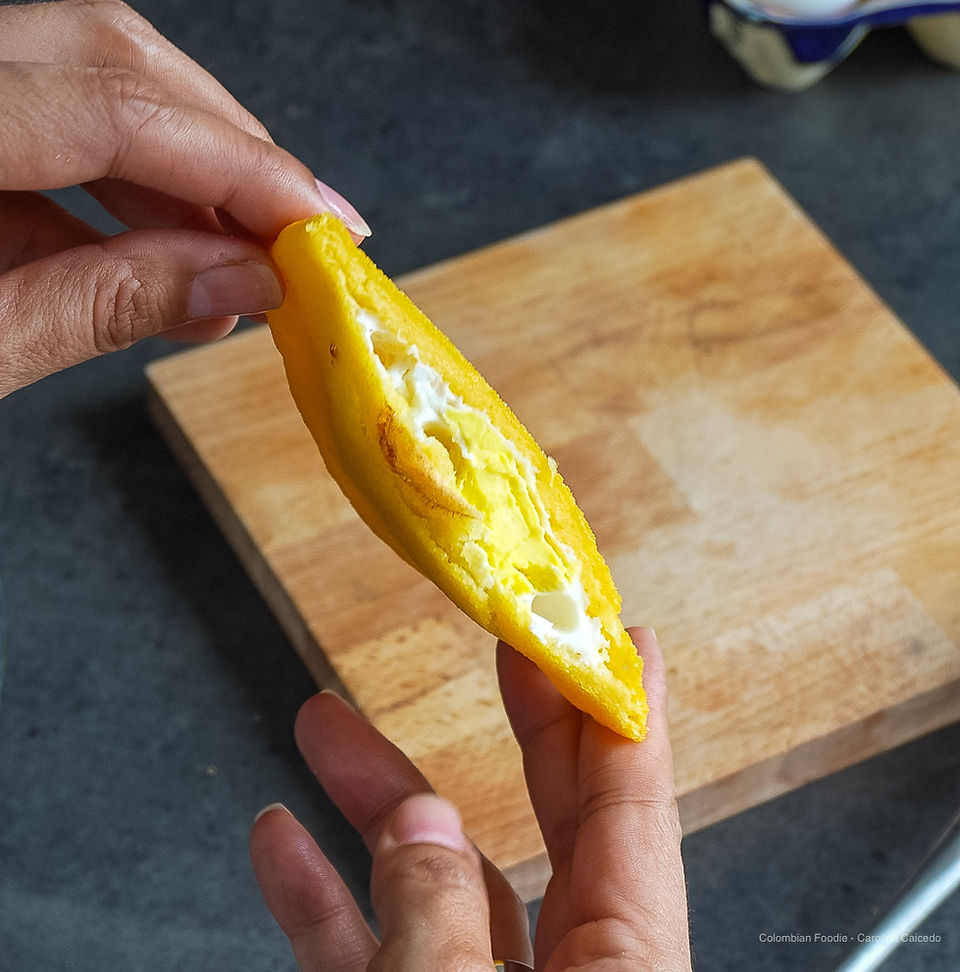
Egg-stuffed arepa
Notes
Egg arepas are best eaten hot, freshly fried or straight out of the Airfryer.
On the Caribbean coast, it’s common to eat them plain as a street snack; they also go well with homemade ají, suero costeño, or pink sauce (ketchup + mayonnaise).
You can add a small spoon of grated cheese or even some pre‑cooked ground meat into the pocket along with the egg.
Pre heat the Airfryer always.
Ideally, eat them right away. If you have leftovers, store them in the fridge and reheat in the Airfryer to regain some crispiness.
Common mistakes & quick fixes
Arepas crack when frying: usually too thin or too dry. Adjust the moisture and thickness of the dough.
Egg stays runny after the second fry: the oil wasn’t hot enough. Fry a bit longer at a controlled temperature.
Too much oil absorbed: likely the oil was too cold when you added the arepa. Properly heat it first.

Quick summary (tips)
Recommended thickness: 4–5 mm
Frying temperature: about 160–170 °C
First frying (puffing): 3–4 minutes
Second frying (with egg): 4–5 minutes
Airfryer: 10 minutes at 170 °C (pre‑bake), then 10 minutes at 200 °C with the egg inside (on a heat‑resistant tray)
Have everything ready before assembling: eggs in small bowls, paper towels at hand, a safe work space.
Egg arepa is a tenderly hybrid snack from the Colombian Caribbean coast: simple in ingredients but rich in flavor. It carries stories of journeys, mixing, and street cooking, and you can now bring a piece of it into your own kitchen, whether in a steamy skillet or a convenient Airfryer. Try it, adjust the times to your own equipment, and enjoy it: the first one might not be perfect, but the second one often feels like a promise kept.
Thank you very much for visiting! Did you like the post? Follow me on our social networks to see more recipes and learn more about my life in Germany.


