
PANDEBONO RECIPE: COLOMBIAN CHEESE BREAD

Pandebono is one of my favorite Colombian amasijos*. It’s similar to chipá, and Cali, the city where I was born, is the Colombian city best known for this bread.
A little history
There are several stories about the origin of pandebono. The most popular one says it was invented by an Italian man who walked the streets selling “pan de bueno” (“good bread”) and, from repeating it so much, the name stuck. There’s no document to back it up, so it’s most likely an urban legend.
What is documented takes us to Hacienda El Bono, which still exists in Dagua, Valle del Cauca. In the late 19th century, Genoveva Reza de Montoya, who ran the house, came up with the idea of making a small bread with a more intense flavor than usual, made with cassava starch, corn, cheese, and eggs. Her family and the farmhands were the first to try it, and they spread the word to workers on neighboring farms. The story goes that “pan del Bono” was offered on Sundays at three in the afternoon, and that the hacienda still does it that way today.

Pandebono spread thanks to the muleteers and the laborers who were building the bridle paths between Cali and Buenaventura, who carried the recipe with them. Even Jorge Isaacs, who supervised the construction of those paths and wrote María in his spare time, mentioned pandebono in his novel.
More than a century later, pandebono made the news again: the platform TasteAtlas, which builds its rankings from user ratings, placed it third on its list of the world’s best breads, behind Malaysia’s roti canai and India’s naan. It also came in third on its list of the best dishes in Latin America, after Brazilian picanha and Argentine asado. In Cali the news was celebrated big time, and with good reason: there, pandebono is so everyday that all it takes is a rain shower for someone to put the coffee on.
Pandebonos in Germany
We know it’s a bit hard to find queso costeño in Germany, although there are companies like Beloso that carry it. If you can’t find it, it’s not the end of the world: you can use feta or Hirtenkäse, made from sheep’s or goat’s milk, which you can find in Turkish shops and which usually comes in a can. You can also make a mix of grated mozzarella (not the mozzarella ball that comes in a bag) with feta or Hirtenkäse.

Queso para pandebonos en Alemania 
Queso para pandebonos en Alemania 
Queso para pandebonos en Alemania 
Queso para pandebonos en Alemania
Ingredients
(About 28 servings)
300 g cassava starch (yuca starch)
400 g precooked cornmeal
40 g melted butter
2 eggs
2 tbsp sugar
450 g feta or Hirtenkäse (see notes)
1 tbsp salt, or to taste
2 1/2 cups (about 600 ml) water or milk
1 tbsp baking powder
Instructions
In a large bowl, add the ingredients. I follow this order:
The cassava starch. Don’t drop it from too high up, so the starch doesn’t fly everywhere.
The precooked cornmeal. At this step, also add the salt and the baking powder, and mix well with a spoon.
The cheese, crumbled beforehand.
The liquid with the sugar. Mix part of the milk or water with the sugar and add it to the mixture. Don’t add all the liquid at once.
The eggs and the butter.
Mix with your hands. Mix well and, if cheese lumps form, break them up with your fingers.
Adjust the texture. Keep adding the rest of the liquid as you notice the dough is dry. It’s ready when you can make a medium-sized ball with your hands and, when you flatten it, it doesn’t crack.
Shape them. Make the pandebonos in a ring shape, as they’re traditionally made, or in a ball shape; if you go with balls, make sure they aren’t too big so they don’t stay raw inside. You can also make them in a stick shape.

Pandebono dough 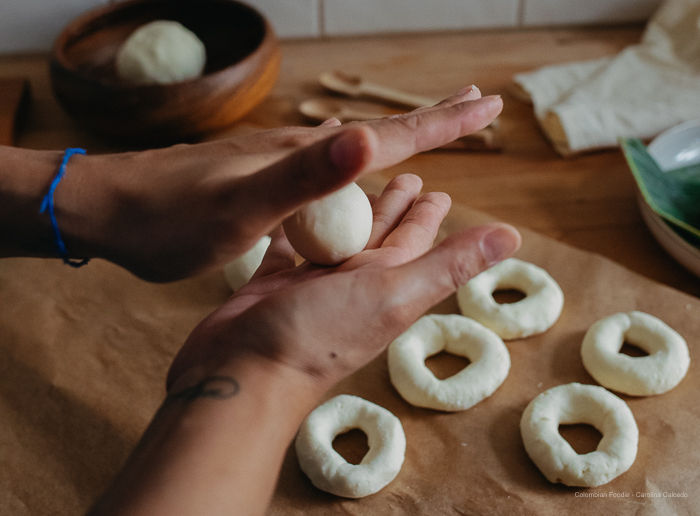
Pandebono dough 
Pandebono dough
Bake. Preheat the oven to 200 °C (about 390 °F) for 10 minutes. Put the tray with the pandebonos in the middle of the oven and lower the temperature to 180 °C (about 355 °F). Baking time depends a lot on your oven; in my electric oven I bake them for 18 minutes at 180 °C and then move them to a higher rack for 5 more minutes so they brown on top. I recommend setting a 10-minute timer and checking on them. For air fryer times, see the notes below.
Enjoy these pandebonos with hot chocolate, hot agua de panela, coffee, or whatever drink you like. You can also serve them with arequipe or dulce de leche as a dip, and you’ll see how delicious it is!

Notes
Cheese: if you live in Germany, you can use queso costeño (for example, from the company Beloso), feta or Hirtenkäse made from sheep’s or goat’s milk, or a mix of grated mozzarella (not the mozzarella ball that comes in a bag) with feta or Hirtenkäse. The canned cheeses from Turkish shops work very well.
Air fryer: it depends on the brand and size of your air fryer. Preheat it for 5 minutes at 180 °C. Add the pandebonos and cook for 10 minutes at 160 °C; then 8 minutes at 180 °C, or until golden.
Fillings: you can fill them with guava paste or arequipe.
Waffles: if you have a waffle maker, you can use this dough to make pandebono waffles.
Storing the dough: you can make the dough, wrap it very well in plastic wrap, and use it for up to 2 days. If you find it too dry later, add a little water or milk.
Freezing: you can freeze the dough already shaped into pandebonos. Before baking them in the oven or air fryer, it’s very important to preheat. Add the pandebonos frozen and use the same times.
*Amasijos: preparations made from cornmeal, starch, or cassava starch, to which butter or margarine, milk, eggs, salt and/or sugar, cheese, or curd are added. These ingredients are kneaded by hand to form a compact dough, which is then baked, fried, or grilled until done.
Sources:
¡Muchas gracias por tu visita! ¿Te ha gustado el post? ¡Sígueme en nuestras redes sociales para ver más recetas y conocer más detalles de mi vida en Alemania!


